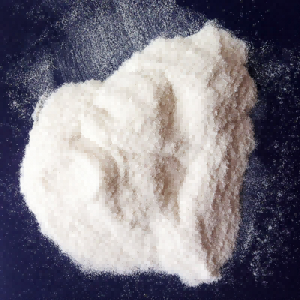
Levulinic acid/CAS:123-76-2


Short Description:
Product Name:Levulinic acid
CAS: 123-76-2
Type:ZA-Y
MF:C5H8O3
MW:116.12
STRUCTURE:

Description:
Levulinic acid has a tart, whiskey taste. It may be synthesized by the action of more or less concentrated HCL on sucrose, glucose, or fructose; hence, its reported presence in caramels.
Specification:
|
Item |
Specification |
| Melting point | 30-33 °C (lit.) |
| Boiling point | 245-246 °C (lit.) |
| Density | 1.134 g/mL at 25 °C (lit.) |
| Vapor pressure | 1 mm Hg ( 102 °C) |
| Refractive Index | n20/D 1.439(lit.) |
| Storage temp. | Store below +30°C. |
| Solubility | 675g/l |
| Form | Liquid After Melting |
| Color | Clear yellow |
Usage
Levulinic acid is a biomass product and its derivatives, such as ethyl levulinate and alkyl levulinate, can be used as fuel additives.
levulinic acid is used for calcium levulinate in pharmaceuticals, as esters in solvents and plasticizers, and for making valerolactone. As its uses expand, it will probably be made from cellulosic wastes. Mesitonic acid, a homolog of levulinic acid is obtained by boiing mesityl oxide with KCN.
Hydrogenation of levulinic acid can produce other useful chemicals. Valeric-g-lactone, which is an effective solvent with extensive uses, can be obtained in very high yields. This compound may be hydrogenated to 1,4-pentandiol, which upon dehydration yields 1,3-pentadine (piperylene). Piperylene is known to polymerize to a rubbery mass and is therefore a source of synthetic rubber (Ghorpade and Hanna 1997).
Levulinic acid is a precursor for the synthesis of useful intermediates such as γ-valerolactone, ethyl levulinate, pentanoic acid and 2-methyl-tetrahydrofuran. Derivatization and esterification of levulinic acid results in potential biofuels.
It can also be used in:
The preparation of catalytic composite to synthesize 5-hydroxymethylfurfural and furfural.
The synthesis of a commercial fragrance, fraistone.
The synthesis of pyrrolidone derivatives via reductive amination.
The total synthesis of mycobacterial arabinogalactan.
Packaging
200KG/Drum or as customer requirements.
Keep and storage
Shelf life:24 month from date of manufacture in original unopened packaging stored in a cool dry place out of direct sunlight, water.
Ventilated warehouse, Low temperature drying, Separated from oxidants, acids.